
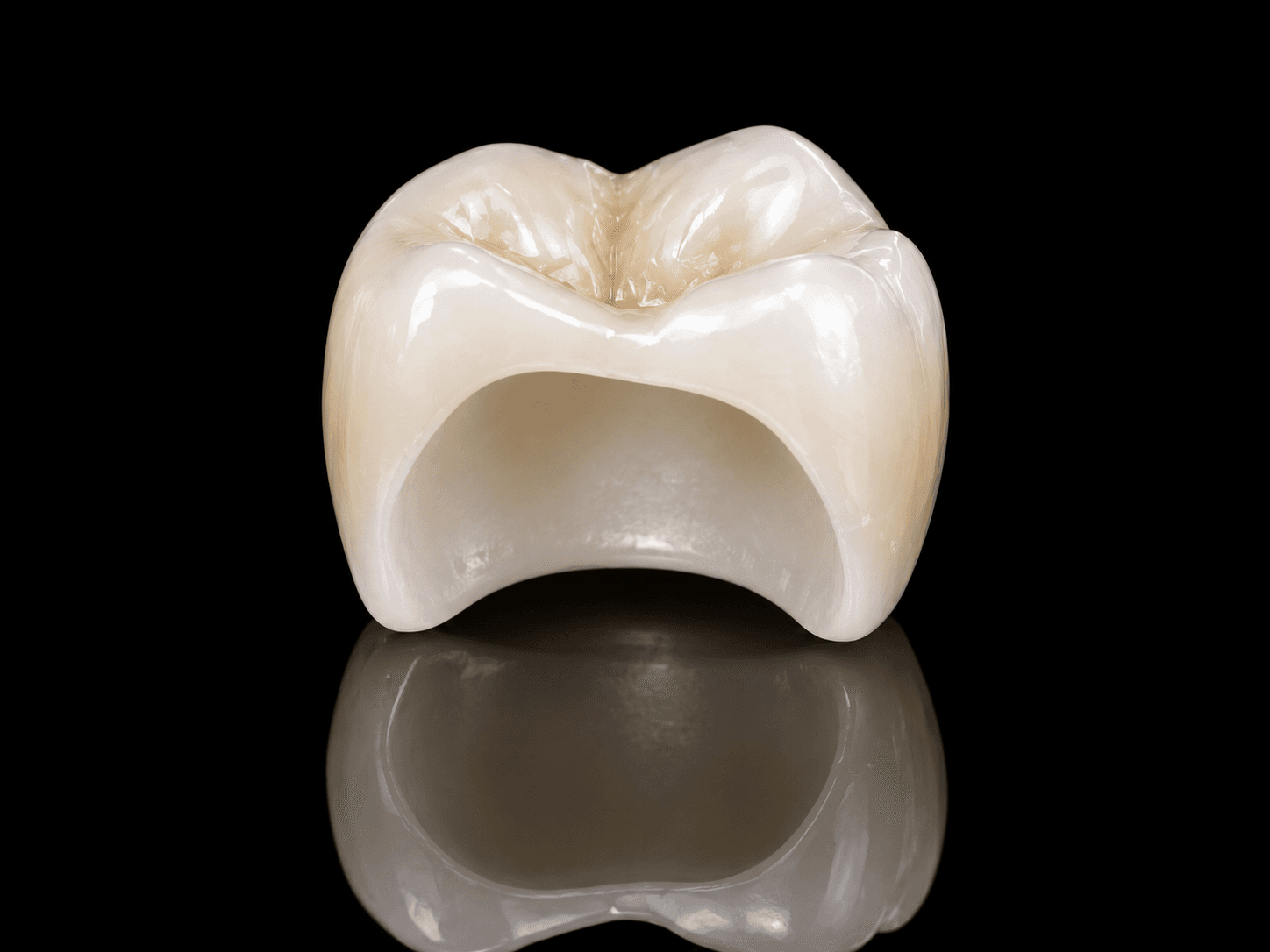
Zirconia Crown
Strong, metal-free and natural-looking.
AED 599 per tooth
- Excellent strength and durability
- Metal-free (all ceramic)
- Natural appearance
- Ideal for back teeth and heavy bite forces
Restore damaged, root-treated or missing teeth with natural-looking, durable crowns and bridges. At Smart Care Polyclinic in Deira, zirconia crowns are AED 599 and PFM crowns AED 399 per tooth, with the consultation free.
Three high-quality options. Our dentist will recommend the best choice for your tooth, bite and budget.
Strong, metal-free and natural-looking.
AED 599 per tooth

A proven and cost-effective option.
AED 399 per tooth

Premium aesthetics for a natural smile.
Price on consultation
A crown covers and protects a damaged tooth. A bridge replaces a missing tooth using the neighbouring teeth for support.
A simple and comfortable process, usually completed in a few visits.
We examine your tooth, review the options and take digital scans or X-rays if needed. The consultation is free.
The tooth is gently reshaped under local anaesthetic, and a digital scan or impression is taken and shade-matched.
A temporary crown protects the tooth while your final crown is made in the laboratory, usually about a week.
Your crown or bridge is tried in, checked for comfort and bite, adjusted if needed, then cemented and polished.
A crown replaces the outer shell of a tooth. The dentist reshapes the tooth into a smaller core, takes an impression or scan, and a dental laboratory makes a crown that fits over it exactly. You wear a temporary crown for about a week, then the final one is cemented in place. Done well, a crown looks and works like the tooth it replaced.
Crowns are the usual recommendation after a root canal on a back tooth. A root-treated tooth has been hollowed out and is brittle. In a cohort of 203 root-treated teeth followed for up to eleven years, those left without a crown were lost at six times the rate of those crowned afterwards.1
The material matters less than people think, and the tooth underneath matters more. A 2026 meta-analysis of tooth-supported single crowns found five-year survival of 97.1% for metal-ceramic, 96.8% for monolithic zirconia and 98.5% for lithium disilicate — all within a couple of points of each other.2 Crowns on living teeth survived best of all, at 98.3% over five years.3
Strong, metal-free and natural-looking. Zirconia is a dense ceramic that resists fracture well, which is why it is the usual choice for molars and premolars that take the heaviest chewing loads. Modern zirconia is translucent enough to be used at the front too, so one material can do the whole mouth.
Monolithic zirconia — milled from a single block — has fewer chipping problems than the older layered kind. The 2026 review found monolithic zirconia and lithium disilicate crowns had significantly fewer ceramic fractures and chips than crowns with a hand-layered porcelain surface.2 That is the type used here.
Best suited to: molars and premolars, teeth under heavy bite forces, patients who want a metal-free option, and anyone who grinds their teeth.
Porcelain fused to metal: a proven combination of strength and value. A PFM crown has a metal core for strength with tooth-coloured porcelain bonded over it. It has been used for decades, and in the largest review of single crowns it survived at 94.7% over five years — essentially the same as the all-ceramic options.4
The trade-off is appearance. The metal core blocks light, so a PFM crown is slightly less translucent than an all-ceramic one, and a thin grey line can show at the gum edge over the years as gums recede. At the back of the mouth that rarely matters; on a front tooth it can.
Best suited to: back teeth, bridges, and anyone who wants a reliable, cost-effective crown where the highest level of translucency is not needed.
Premium translucency for front teeth. E.max is lithium disilicate, a glass-ceramic that mimics the way natural enamel transmits light. It is chosen when the crown will be in full view and matching the neighbouring teeth precisely is the priority.
As a single crown it performs very well; as a bridge it does not. A systematic review found lithium disilicate single crowns survived at 97.8% at five years and 96.7% at ten, but the same material used as a bridge survived only 78.1% at five years, with most failures at the back of the mouth.5 So E.max is a front-tooth crown material, not a bridge material.
Best suited to: front teeth and other highly visible teeth, smile makeovers, and patients who want the most natural cosmetic result.
An inlay or onlay is a lab-made restoration that replaces part of a tooth rather than covering all of it. An inlay sits within the chewing surface; an onlay also covers one or more cusps. They are used where a large filling would be weak but there is still enough healthy tooth to avoid cutting it down for a full crown.
The dentist will say at the consultation which is right, because the decision depends on how much sound tooth is left — something only an examination and an X-ray can show.
A bridge is a false tooth held by crowns on the teeth either side of the gap. It is fixed, not removable, and needs no surgery, which is why it remains the usual alternative to an implant. It does mean the two supporting teeth are crowned.
Bridges last well, and the material choice is between PFM and zirconia. Conventional tooth-supported bridges survived at 93.8% over five years and 89.2% over ten in a major review; the commonest problems were decay or nerve damage in the supporting teeth rather than the bridge breaking.6 Comparing materials, metal-ceramic bridges reached 94.4% and zirconia 90.4% at five years, a difference that was not statistically significant.7
A bridge is priced per unit — each crown and each false tooth counts as one — and the dentist gives you the whole figure before anything starts.
Visit one: the tooth is numbed and reshaped, any old filling or decay is removed and the core is built up where needed, an impression or digital scan is taken, the shade is matched to the neighbouring teeth, and a temporary crown is fitted.
Visit two, about a week later: the temporary is removed, the final crown is tried in, checked for fit, contact and bite, adjusted if needed and cemented. Mild sensitivity for a few days is common and settles.
Aftercare: brush and floss the crown like a natural tooth. The crown cannot decay, but the tooth under its edge can, which is why the gum line around it matters most.
| Crown type | Strength | Appearance | Commonly used for | Price per tooth |
|---|---|---|---|---|
| Zirconia | Excellent | Excellent | Front and back teeth, heavy bites | AED 599 |
| PFM | Very good | Good | Back teeth and bridges | AED 399 |
| E.max | Very good | Excellent | Front and visible teeth | Quoted at consultation |
At Smart Care Polyclinic in Deira, a zirconia crown is AED 599 per tooth and a PFM (porcelain fused to metal) crown is AED 399 per tooth. E.max crowns are quoted at the consultation. The consultation itself is free, and you have the full figure before any tooth is prepared.
For a back tooth under heavy chewing forces, either works well; zirconia is metal-free and slightly more natural-looking, PFM is the more economical. For a visible front tooth, zirconia or E.max gives the better cosmetic result. The dentist will recommend one based on the tooth, your bite and how much natural tooth remains.
Across the largest reviews, roughly 95 to 98 out of 100 crowns are still in place after five years, whatever the material. Beyond that, what matters most is keeping the gum edge clean, not grinding on it, and the health of the tooth underneath. Ten to fifteen years is common with good care; nobody can promise a figure for one tooth.
Usually yes on a back tooth. A root-treated tooth is hollow and brittle, and the study evidence shows root-treated teeth without a crown are lost at around six times the rate of those with one. A front tooth with plenty of structure left can sometimes be filled instead; the dentist will say which applies.
The tooth is numbed with local anaesthetic before any preparation, so the appointment itself should not hurt. Some sensitivity to hot and cold for a few days afterwards is normal. If the tooth is already root-treated there is no nerve to feel anything.
No. Whitening only changes natural enamel. If you are planning to whiten, do it first and have the crown shade-matched to the result.
This guide is general information about a treatment, not advice about your teeth. Which option suits you depends on the tooth, your bite, your gums and what you want long term — all of which the dentist assesses at your free consultation before anything is agreed.
Sources are listed for the specific statements they support. They are published research and guidance, not a substitute for a consultation — what applies to you is decided by a doctor who has assessed you.
Read more: Dental Crowns: Which Type Is Right for You?